
Why the Western Balkans Is Becoming an Operational Hub for DACH and UK Companies
For companies in Germany, Austria, Switzerland and the UK, Bosnia and Herzegovina offers specialist talent in a market that is not yet crowded, an hour from Munich and in the same time zone.
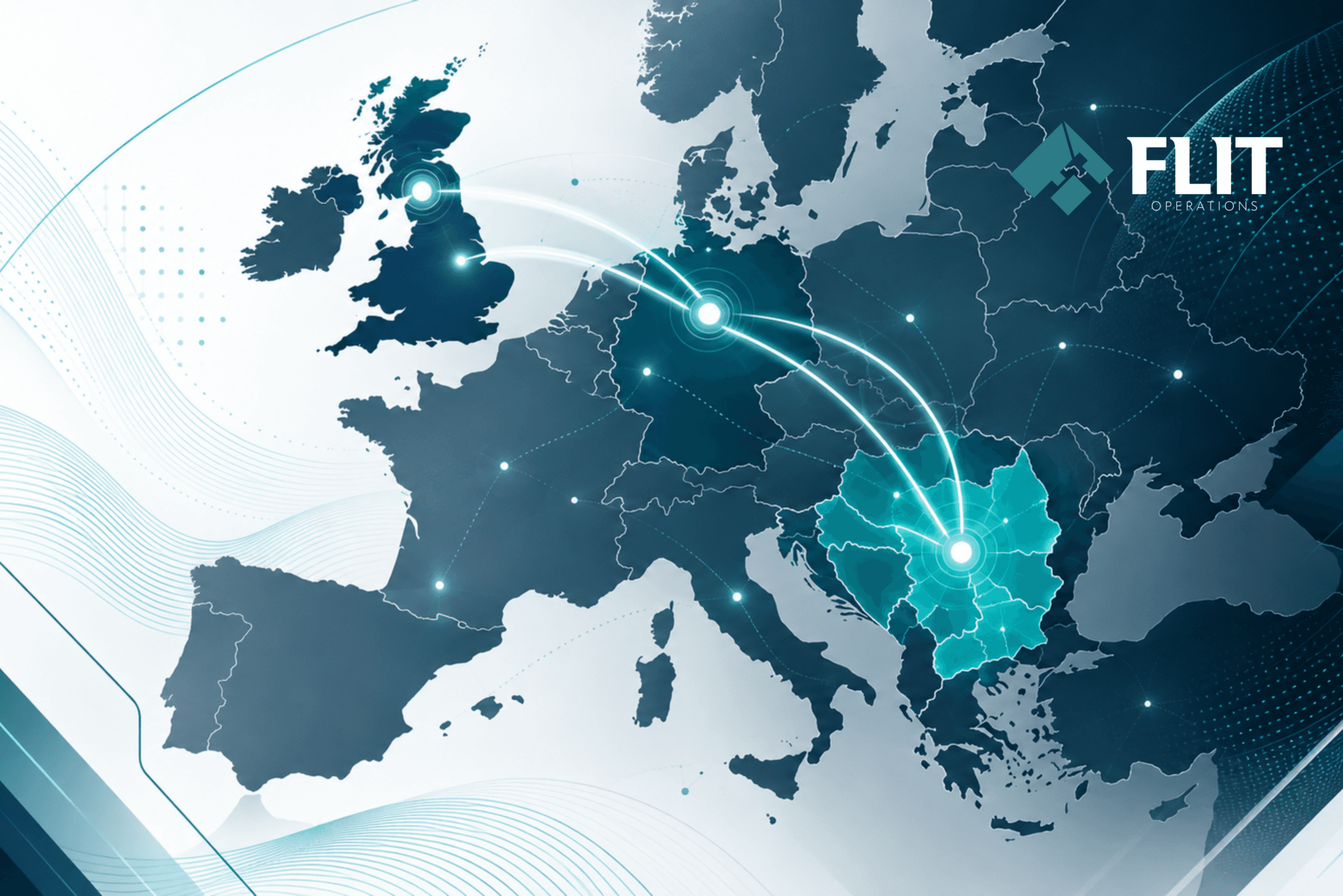
For companies in Germany, Austria, Switzerland and the UK, the Western Balkans has become a practical place to run operations. It has specialist talent in a market that is not yet crowded, and it works in the same time zone as Berlin, Vienna and Zurich. Bosnia and Herzegovina shows the case most clearly: Sarajevo is about an hour’s flight from Munich, and the country’s currency is fixed to the euro.
European companies looking for outsourcing partners have traditionally looked east or south, towards large talent pools and established BPO infrastructure. That pattern is shifting, and the reasons go beyond cost or geography. This article looks at the region from a DACH and UK point of view, using Bosnia and Herzegovina, where Flit Operations has its delivery centre in Sarajevo, as the concrete case. For the wider regional picture, see why the Balkans are becoming Europe’s next operational hub.
Why are DACH and UK companies looking beyond their home labour markets?
Because for specialist roles, the people are hard to find at home. Germany’s IT sector is the clearest example. Bitkom reported in September 2026 that the German economy is short of 79,000 IT specialists, and that 97% of companies with IT vacancies have difficulty filling them (Bitkom, 2026). The gap is smaller than in 2023, when it stood at 149,000, but it is still large. It is one reason companies hand cybersecurity and managed IT to a nearshore team instead of waiting months for a hire.
The same pressure shows up in finance, legal and compliance. Our view is that much of this demand can no longer be met from home labour markets alone, so the first option is nearshore, with offshore further down the list. Nearshore means a team close enough to work with your own people every day, not a capacity pool on the other side of the world.
What does the talent pool in Bosnia and Herzegovina look like?
It is more qualified than the country’s size suggests, and much of it is available. In 2025, Bosnia and Herzegovina’s labour force was 1.423 million people, of whom 22.5% held a college, university, master’s or doctoral degree, and 173,000 people were unemployed, a rate of 12.2% (Agency for Statistics of Bosnia and Herzegovina, 2025). For an employer, that means qualified people are still looking for work.
The education system is the foundation. John Callachan, founder and director of Flit Operations and of Go Fusion, has worked in BPO for more than 30 years across 13 locations. He has watched this develop at first hand: “The Western Balkans have done an amazing job within their educational system. Very tech-first, the ecosystems they’re building in this area, driving tech-enabled people, is outpacing all of their rivals.”
That assessment comes from building and running operations in many markets, so the comparison is a practical one, not a theoretical one. It matters because the work most DACH and UK companies now want to move is not high-volume processing. It is finance, legal, compliance and technology work that needs analytical training and the confidence to use it. High-skill BPO talent is what makes those functions possible to hand over.
Is the BPO market in the Western Balkans saturated?
Not yet, and for a company choosing a partner now, that is a practical advantage. In more mature outsourcing destinations, years of fast growth have made some specialist profiles scarce and pushed salaries up. John Callachan sees the Western Balkans at an earlier stage: “BPO is still fairly new here, so it’s not saturated. We’re not through saturation, where a lot of other countries in that region are.”
For a long-term decision, timing matters. A partnership built before a market matures gets strong people without a bidding war for them, and a partner that still has the capacity to take the work on properly. That window will not stay open indefinitely. As more European companies look at the region seriously, the conditions that now favour early movers will shift. How the region compares with established outsourcing markets sets out the data on both sides.
How do time zone, travel and culture work in practice?
Bosnia and Herzegovina runs on Central European Time, the same as Germany, Austria and Switzerland, and one hour ahead of the UK. A DACH team and a team in Sarajevo share the whole working day, and UK office hours overlap almost entirely. Munich is about an hour’s flight away, so senior people can visit the team, and the team can visit head office, without losing a week to travel.
Cultural alignment goes deeper than geography. Teams in the region have developed through years of work with Western European clients, which shapes how they communicate, how they handle a client relationship and how they apply the standards DACH and UK businesses expect. John Callachan describes it as a real advantage: “The people understand cultural alignment. Everything here is set up just at the right time.”
In practice, cultural fit shows up in small decisions. A good team knows when to raise an issue before it grows, when to ask for clarification and when to use its own judgment instead of waiting for instructions. A team that gets those right needs far less management, and working with it feels closer to working with an internal team than with a distant provider.
What do finance and compliance teams need to know?
Is Bosnia and Herzegovina on the way into the EU?
Yes. It applied for EU membership in February 2016, the European Council granted it candidate status in December 2022, and in March 2024 the European Council decided to open accession negotiations (European Commission, 2026). Candidate status does not, however, change the legal position for personal data today.
How does GDPR apply to a team in Sarajevo?
Bosnia and Herzegovina has no adequacy decision: it is not on the European Commission’s list of countries with adequate data protection. Transfers of personal data from the EU therefore need a safeguard, normally the Commission’s standard contractual clauses together with a transfer impact assessment. The other route is to keep the data on your own EU systems and have the team work inside them. Either way, agree the basis in writing before any data moves.
What about currency risk?
The convertible mark is tied to the euro under a currency board, at a fixed rate of 1.95583 KM to one euro set by the Central Bank of Bosnia and Herzegovina. Costs in Sarajevo therefore move with the euro. Swiss and UK companies keep their usual franc or sterling exposure to the euro, but there is no second currency risk on top of it.
What does AI change about the talent you need?
As AI tools become a standard part of operational delivery, the people who do well with them are those with strong analytical foundations. They can judge outputs that vary and question what a tool produces when the situation calls for it. John Callachan sees this as part of the region’s long-term position: “You need high skill set, intelligent people. That fits culturally well in Bosnia and the movement towards AI augmentation.”
For a DACH or UK company, the point is durability. A team built today should still fit when more of the routine work is automated and more of what people do is judgment. Building that team around analytical capability now is how you avoid rebuilding it later.
What should you check before moving work to Sarajevo?
- Start with one process. A single, well-understood process shows how the team works before you widen the scope.
- Document how it runs today. Include the exceptions and who decides what, so nothing depends on one person’s memory.
- Agree the data protection basis in writing. Standard contractual clauses or work on your own EU systems, settled before any data moves.
- Confirm the working language. Decide whether the process runs in German, English or both, and check the team covers it.
- Ask for one named contact. Someone who answers for the service and reports on volumes and exceptions.
Frequently asked questions
Is Bosnia and Herzegovina in the EU?
No. It has been an EU candidate country since December 2022, and in March 2024 the European Council decided to open accession negotiations. For data protection purposes, it is still treated as a third country.
Can a team in Sarajevo work with EU personal data under GDPR?
Yes, with the right safeguards. Bosnia and Herzegovina has no EU adequacy decision, so transfers normally rely on standard contractual clauses and a transfer impact assessment. The alternative is to keep the data on the client’s EU systems and have the team work in them.
What time zone is Sarajevo in?
Central European Time, the same as Germany, Austria and Switzerland and one hour ahead of the UK. Munich is about an hour’s flight away.
How large is the labour pool in Bosnia and Herzegovina?
The labour force was 1.423 million people in 2025, and 22.5% of them held a higher education degree. With unemployment at 12.2%, qualified people are still available, and the BPO market has not reached saturation.
Flit Operations runs finance, legal and compliance, IT, logistics and procurement, and front and back office work for companies in Germany, Austria, Switzerland and the UK from Sarajevo. Read why the work sits in Sarajevo, or book a 30-minute call to talk through the process you have in mind.
See why the work sits in Sarajevo and what a first process looks like.
Read next

Tell us which process is costing you most
Thirty minutes, nothing to prepare. You describe the process; we tell you honestly whether we are the right team for it.